

The problem nobody warns you about
Learning how to use AI to handle difficult freelance clients can save your work, your time and your reputation. In this guide, you will learn how to stay calm, reply professionally and keep the client without losing the project.
Most freelancers in Pakistan prepare for the hard part wrong. They spend weeks learning a skill, building samples and setting up a profile, and they assume the work itself will be the hard part.
Then the first difficult client arrives, and they realise the work was never the hardest bit. The hardest bit is the person on the other side of the screen.
A difficult client is not always a rude client. Sometimes it is a client who changes the brief after you have finished. Sometimes it is a client who goes quiet for a week and then returns with an urgent deadline. Sometimes it is a client who asks for one more small change, and then another, and then another, until the small job you agreed to has become a large job at the same price.
Sometimes it is a client who questions every decision you make and makes you feel as if you know nothing, even when you do.
The usual advice is to stay calm and be professional. That advice is correct and almost useless, because it does not tell you what to actually say, what to actually write, or when to actually stop. This article is about that practical part, and about one tool that helps with it: AI, used as a thinking partner for the conversations that are hardest to handle well when you are tired, annoyed, or worried about losing the payment.
Table of Contents
First, work out what kind of difficult you are dealing with
Before you reply to a difficult message, stop and name what is happening. AI cannot do this for you unless you can describe it, and you cannot reply well until you know which problem you are solving. Most difficult clients fall into a few patterns, and each one needs a different response.
1. The Scope Changer
You agreed to design three social media posts. Now the client wants a logo as well, and a flyer, and a video, all for the same price. The problem is not the extra work itself. The problem is that nobody agreed to it, and nobody agreed what it costs.
2. The Slow Payer
The work is done, the client is happy, and the payment is always coming tomorrow. Tomorrow stretches into next week. The problem here is not the amount. It is the uncertainty, because you cannot plan your month around money that has not arrived.
3. The Silent Client
You send the work, you ask a question you need answered before you can continue, and nothing comes back. Days pass. Then the client returns and wants everything finished today. The problem is a broken rhythm, not a bad person.
4. The Endless Reviser
The work is never quite right, not because it is bad, but because the client keeps changing their mind about what right looks like. Every round of changes moves the target a little further away.
5. The Rude Client
Short messages, blame, threats about a bad review, pressure to work faster for less. This one is different from the others, because the problem is not a misunderstanding. It is behaviour.
Naming the pattern matters because it stops you from answering every problem with the same reply. A scope changer needs a boundary and a price. A slow payer needs a reminder and a deadline. A silent client needs a clear question and a date. An endless reviser needs a limit on revisions. A rude client needs a short, firm message and, sometimes, an exit.

How AI actually helps here
AI is useful with difficult clients for a simple reason. It is not upset. You are. When a client sends a message that makes your stomach tighten, your first draft of a reply is usually written by the annoyed part of your brain. It is too sharp, or too soft, or too long, or it agrees to something you will regret. AI gives you a second draft, written by something that has no feelings about the client at all.
That does not mean you should let AI write your replies and send them without reading them. You should not. The client hired you, not a machine, and a reply that sounds like a machine wrote it will make a difficult situation worse. What AI is good for is helping you think clearly before you reply, and helping you say a hard thing in plain, polite language.
Here is a way to use it that works. Paste the client’s message into your AI tool, then write, in your own words, what you want to happen. Not what you want to say, but what you want to happen. For example: “I want the client to pay for the extra work, keep the relationship, and finish this job by Friday.” Then ask the AI to draft a short reply that does that, in a calm and professional tone. Read what it gives you. Cross out anything that sounds fake. Keep the sentences that sound like you on a good day. Send that version.
The same approach works before a call. If you need to talk to a client about a late payment, ask AI to list the three points you need to make, in order, and the one sentence you should open with. Going into a hard conversation with three points in your head is very different from going in with a knot in your stomach and hoping for the best.
AI is also useful for turning a long, messy chat into a short summary. Freelance work in Pakistan often happens across WhatsApp, Fiverr messages, Upwork messages and email, sometimes all for the same job. After a week of that, nobody remembers exactly what was agreed. Paste the conversation into AI and ask it to list what was agreed, what is still open, and what is still unpaid. Read the summary carefully, because AI can get details wrong, and correct it. Then send the corrected version to the client and ask them to confirm it. That one message prevents more arguments than any other habit in freelancing.
Scope creep: the extra work that was never agreed
Scope creep is the problem most Pakistani freelancers face first, and it is the easiest to handle once you have a method for it. The method is simple, but it needs to happen in writing, before you do the extra work.
When a client asks for something beyond the original job, do not answer with yes or no straight away. Answer with a clarification. Say what the original job was, say what the new request is, and say what it will cost and how long it will take. Then ask the client to confirm.
AI can help you write that message without it sounding like an argument. Give it the facts: the original job, the new request, your price for the extra work, and the new delivery date. Ask it to draft a short message that states those facts plainly.
The important part is not the wording. It is the order. You state the extra work, then the price, then you wait for confirmation. You do not start the work and mention the price later. You do not do the work for free and hope the client notices. You do not argue about whether the extra work is small. Small is a matter of opinion. Price is a matter of agreement.
If the client says the extra work should have been included, go back to the original agreement. Quote it. Not angrily, and not in a long message, but clearly. “We agreed on three posts. The logo was not in that agreement.” That is a fact, not an accusation. If you do not have the original agreement in writing, write it down now, send it to the client, and ask them to confirm it before you continue. From then on, get every agreement in writing, even if it is only a short message in the same chat.
Late payment: how to chase money without burning the relationship
Chasing payment is uncomfortable for almost every freelancer, and it is worse when the client is in another country and you have never met them. Many beginners in Pakistan simply wait, because they are afraid that asking for money will lose them the client. Waiting does not help. It teaches the client that late payment has no consequence.
The first rule is to agree payment terms before you start. Not after, and not in the middle. Before. That means the total price, how much is paid upfront if anything, when the rest is paid, and how the client will pay. Write it in the same place you agreed the work. If you are working through a platform, the platform already sets some of these rules. Follow them, and do not agree to move payment off the platform to save fees, because you lose the protection the platform gives you.
The second rule is to send a reminder that is short, polite and specific. AI is genuinely good at this, because reminders are one of the few messages where a calm, standard tone is exactly right. Give AI the facts: the job, the amount, the date it was due, and the payment method. Ask for a reminder that states those facts and asks when the payment will be sent. Then read it, remove anything that sounds stiff or threatening, and send it.
If the client replies that they will pay soon, ask for a date. “Soon” is not a date. A date is something you can check. If the date passes and nothing arrives, send one more reminder, shorter than the first, and say what happens next. That might be that you will pause the work until the payment arrives, or that you will close the job on the platform. Say it plainly, once, and then do what you said.
Getting paid in Pakistan has its own practical details. PayPal cannot be used to receive payments in Pakistan, so do not plan around it. The route most Pakistani freelancers actually use is Payoneer. When you withdraw Payoneer to JazzCash, the minimum is 5 dollars and Payoneer charges a 3 percent fee. Check the exact figures inside the app before you withdraw, because fees do change, but that is the figure JazzCash itself publishes. Keep a record of every payment and every reminder you send, because if a dispute ever reaches the platform, the record is what decides it.
There is also a tax point worth knowing once you are earning regularly. If you register with the Pakistan Software Export Board, the income tax rate on freelancing income is 0.25 percent, compared with 1 percent for unregistered freelancers, under Section 154A of the Income Tax Ordinance. I am not a tax adviser, and rules can change, so check the current guidance before you rely on it. The point for this article is simpler: keep records from day one, because a payment dispute and a tax question both get easier when you can show what happened and when.
When the client goes quiet
Silence is not rejection, but it feels like it. You have sent the work, asked a question, and heard nothing. The worst response is to send five messages in a row, each one more worried than the last. The best response is one clear message with a question and a date.
AI can help you write that message, but the thinking behind it is yours. Work out what you actually need from the client to continue. Usually it is one thing: approval of a design, an answer about the text, a file you are waiting for, or confirmation of a date. Ask for that one thing, and give a date by which you need it. Say what you will do if you do not hear back by then. That might be that you will move on to other work and return to their job when they reply, or that you will deliver what you have and close the job.
This is not a threat. It is information. A busy client often replies to a message with a date in it, because a date makes the job real again. A client who has lost interest will not reply, and that is also information, because it tells you to stop waiting and use your time elsewhere.
If the client returns after a long silence and wants everything finished at once, do not pretend the delay never happened. Say what has changed. The work will take this long from today. The price is the same, or the price has changed because the rush changes the work. Then ask them to confirm.
Endless revisions: how to stop the loop
Revisions are normal. Endless revisions are not, and the difference is usually a missing limit. When you agree a job, agree how many rounds of revisions are included. Two rounds is common. Say it in writing. Then, when the client asks for a third round, you are not refusing. You are referring to what was agreed.
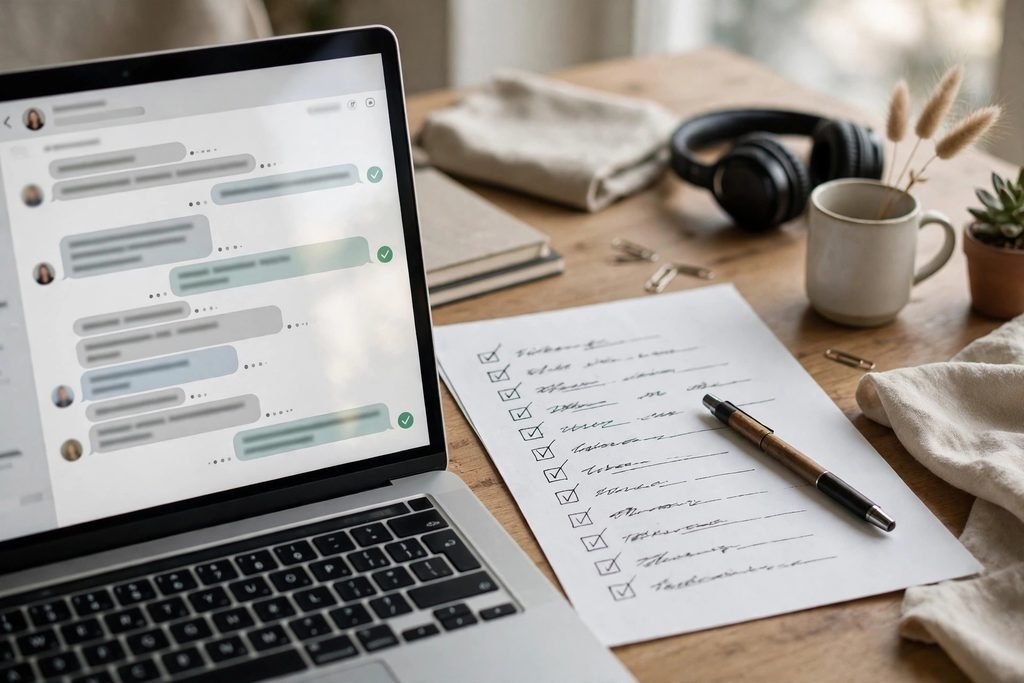
AI helps here in a way beginners often miss. When a client sends a long message full of small changes, ask AI to turn it into a numbered list. Then go through the list and mark each item as done, not possible, or extra work. Send the list back to the client and ask them to confirm it. This does three things. It shows the client you have read everything. It makes the changes concrete instead of vague. And it makes it obvious when a new round of changes is actually a new request, not a revision.
The other half of stopping the loop is asking better questions at the start. Before you begin, ask the client for examples of what they like. Ask what they do not like. Ask who will approve the work, because a job approved by one person and then rejected by their boss is a common trap. AI can help you draft those questions, but you have to ask them.
If a client keeps changing their mind about the whole direction, that is not a revision. That is a new brief. Say so, kindly, and price it as a new brief.
The rude client, and when to walk away
This is the hardest section to write, because walking away from paid work feels wrong, especially when money is tight. But some clients cost more than they pay. They cost you sleep, confidence, and time you could spend on clients who treat you well.
A rude client is not a client who gives honest feedback. Honest feedback sounds like this: the design does not match our brand, please change the colours. A rude client sounds like this: this is terrible, you do not know what you are doing, fix it now or I will leave a bad review. The first is about the work. The second is about you.
For the first rude message, reply short. Do not defend yourself at length. Do not apologise for things you did not do. State what you will do next, and when. AI can help you draft a short reply that stays calm, but do not let it make you sound like a customer service script.
For the second rude message, use the platform. If you are on Fiverr, remember that Fiverr takes 20 percent of every order, and in return you get a system for disputes and reviews. Use it. Keep every message on the platform, because messages outside the platform do not count if there is a dispute. Do not move the conversation to WhatsApp to make it easier, because easier for the client often means harder for you later.
For a threat about a bad review, do not panic. One bad review does not end a freelancing career, and a review that is clearly unfair is often obvious to other clients who read it. What ends a career is accepting treatment that makes you hate the work. If a client threatens you, document it, report it through the platform if the platform allows it, and consider ending the job. Ending a job is not failure. It is a decision.
There is one exception to be careful about. Sometimes a client sounds rude because English is not their first language, or because they are under pressure from their own boss, or because they are writing quickly on a phone. Before you decide a client is rude, read the message again and ask AI to rewrite it in a neutral tone. If the neutral version sounds reasonable, the problem may be tone, not intent.
Using AI without losing your own voice
AI is a useful tool for difficult clients, but it has limits, and knowing them matters more than knowing the prompts.
AI does not know your client. It does not know that this client always replies late on Fridays, or that this client prefers short messages, or that this client is actually kind but writes badly. You know those things. Use them.
AI does not know your limits. It will happily draft a reply that agrees to extra work for free, or promises a delivery date you cannot meet, if you ask it to. Read every draft before you send it, and check the facts: the price, the date, the number of revisions, the payment method. If any of those are wrong, fix them yourself.
AI should not be used to fake experience you do not have, or to write work you cannot do. If a client asks you to do something you do not know how to do, the honest answer is to say so, and to say what you can do instead.
Keep a simple habit. After a difficult exchange is over, write down what happened, what you said, and what worked. Not a long diary, just a few lines. Over a few months, you will have your own guide to difficult clients, written from your own experience, and that guide will be more useful than any article, including this one.
A simple way to handle the next difficult client
The next time a difficult message arrives, try this order. It is short enough to remember when you are stressed.
First, wait. Do not reply in the first five minutes. Read the message twice. Name the pattern: scope change, late payment, silence, endless revisions, or rudeness.
Second, write down what you want to happen. Not what you want to say, but the result. Payment by Friday. Agreement on the extra work. A clear answer to one question.
Third, use AI to draft a short reply that aims for that result. Read it. Remove anything that does not sound like you. Check the price, the date and the facts.
Fourth, send it, and write down what you agreed. If the client confirms, you have a record. If they do not, you have a clear next step.
Fifth, if the same problem happens again with the same client, do not repeat the same reply. Change the approach. A second scope change needs a firmer boundary than the first. A second late payment needs a date, not a reminder. A second rude message needs a short reply and a decision about whether to continue.
Freelancing in Pakistan is a real way to earn, but it is not only about skill. It is about handling people well when the work gets awkward, protecting your time, and knowing when a job is worth keeping and when it is worth letting go. AI will not do that for you. What it can do is give you a calmer first draft, a clearer summary, and a little space to think before you reply. Used that way, it does not replace your judgement. It gives your judgement room to work.
FAQs
Can I use AI to reply to my freelance clients?
Yes, but use it to draft, not to send directly. Always read the draft, fix the price, date and facts, and make it sound like you before sending.
How do I stop scope creep as a freelancer?
Agree the work, price and revision limit in writing before you start. When extra work comes, state the price and wait for confirmation before you start it.
How do I ask a client for late payment politely?
Send a short reminder with the job, amount and due date. If they say “soon”, ask for a specific date. If the date passes, send one more reminder and say you will pause work.
Should I walk away from a rude client?
If a client is rude more than once, threatens you, or costs you more stress than the payment is worth, yes. Document everything, keep messages on the platform, and end the job professionally.
Is freelancing with AI allowed on Fiverr and Upwork?
Yes, using AI as a helper is allowed, but you must deliver original work you have checked yourself. Do not deliver unchecked AI work or fake experience.
Hamza writes beginner guides on freelancing, earning online, digital skills, payments and AI tools
for readers in Pakistan at Dawraan. For a longer step-by-step guide to starting out, visit
https://dawraan.com/how-to-start-freelancing-in-pakistan/