
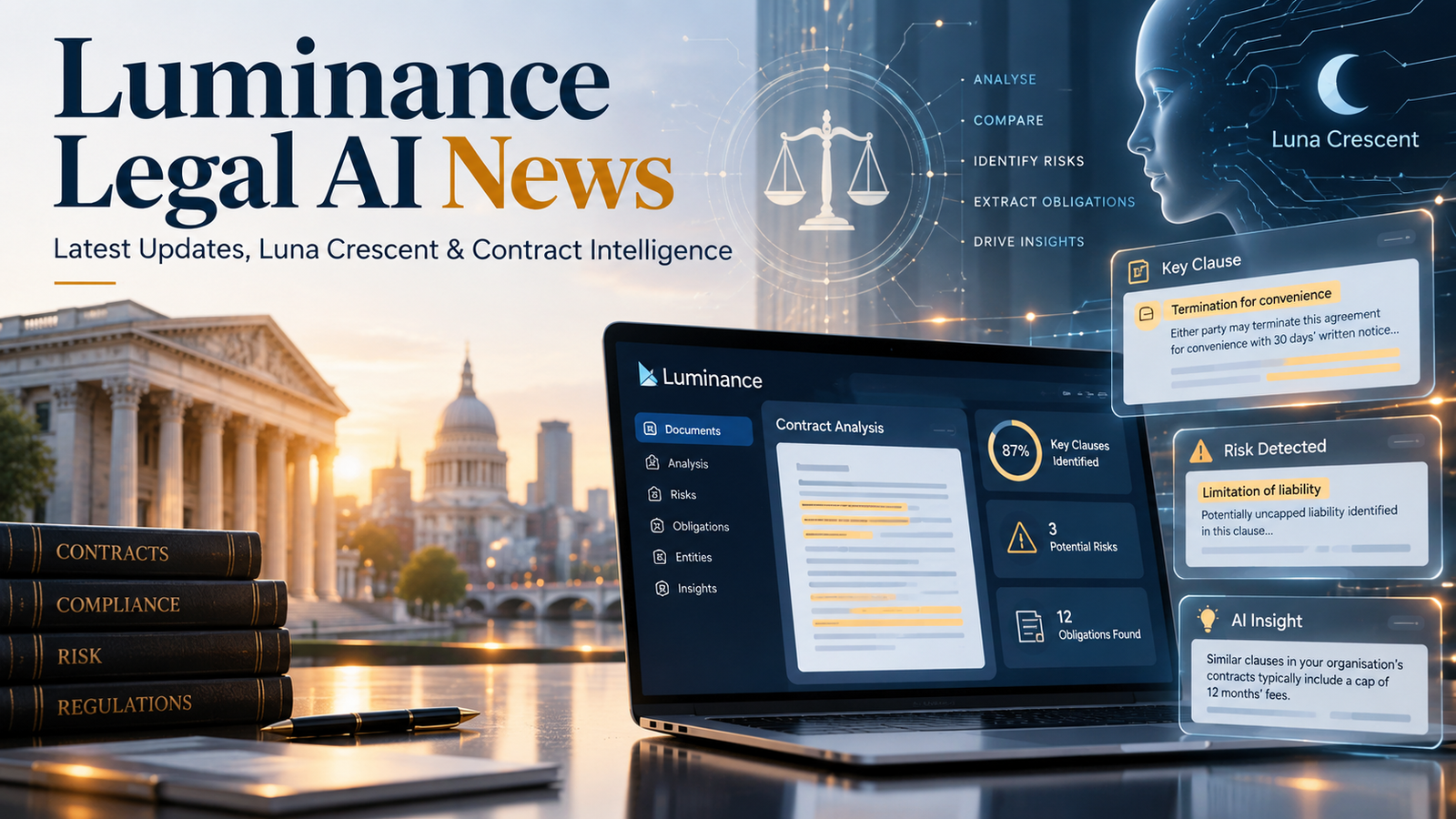
| SEO PUBLISHING BRIEFPrimary keyword: luminance legal ai newsRecommended SEO title: Luminance Legal AI News 2026: Luna Crescent, Contract Intelligence & Latest UpdatesSuggested slug: /luminance-legal-ai-news/Suggested meta description: Follow the latest Luminance Legal AI news, including Luna Crescent, Contract Intelligence, the LexisNexis alliance, enterprise deployments and what the changes mean for legal teams.Search intent: Informational + current news / product researchRecommended schema: Article or NewsArticle, plus visible FAQ content where appropriate |
Luminance Legal AI News: Why 2026 Is a Defining Year for Contract Intelligence
Legal AI is moving beyond one-off drafting assistants and document summaries. In 2026, Luminance has increasingly positioned its platform around a broader idea: contracts should function as a continuously useful source of business intelligence, not as files that disappear into a repository after signature. That shift is visible across the company’s major announcements this year, from institutional memory and a strategic alliance with LexisNexis to the launch of its Luna Crescent model and a renewed emphasis on Contract Intelligence. Source: Luminance: Contracts are everyone’s business
For readers searching for “luminance legal ai news,” the important story is therefore not a single product release. It is the way Luminance is trying to connect contract review, negotiation history, portfolio search, source-backed answers and business workflows into one system. The company describes the result as Contract Intelligence: the ability to understand, connect and activate the content, history and context contained across an organization’s agreements. Source: Luminance: What is Contract Intelligence?
| QUICK TAKEAWAYS• January 27: Luminance announced a major platform update designed to retain negotiation history and legal decision context across enterprise contracts.• April 21: LexisNexis and Luminance announced a strategic alliance to bring citation-backed legal intelligence into Luminance contract workflows for mutual in-house customers.• June 19: Luminance introduced Luna Crescent, the first model in its proprietary Luna family, built for specialist contract tasks.• September 22: Luminance publicly emphasized Contract Intelligence as the next chapter of its enterprise strategy.• September 24: Legal IT Insider reported that Cryptomathic had deployed Luminance to broaden business access to contractual information and reduce routine legal-team queries. |
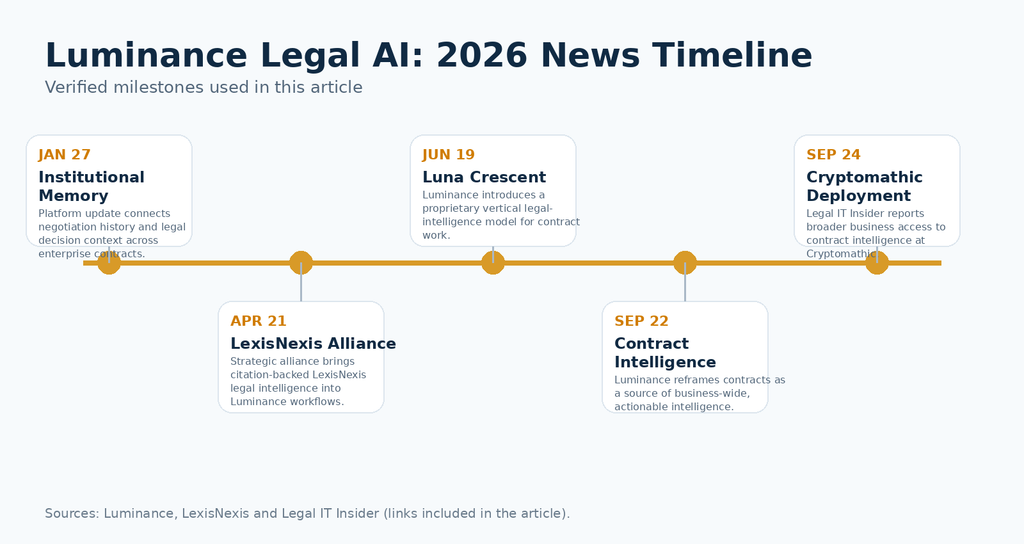
Figure 1. Major Luminance legal-AI developments in 2026.
What Is Luminance Legal AI?
Luminance is an enterprise-focused AI platform centered on contracts. Its public product pages describe capabilities for negotiation, contract discovery, workflows and portfolio-wide intelligence. In practical terms, the platform is designed to help legal and business teams identify unusual terms, locate obligations, compare positions, surface risk, use organizational precedent and answer questions across contract collections. Source: Luminance platform overview
That focus matters because contract work is different from open-ended writing. A contract question may depend on definitions, amendments, exceptions, schedules and relationships between clauses. A useful legal-AI system therefore has to retrieve the right source material before it can generate a useful answer. Luminance’s current technology messaging places strong emphasis on context retrieval, specialist intelligence and validation rather than relying on a single general-purpose model for every task. Source: Luminance technology architecture
January 2026: Institutional Memory Becomes a Core Theme
On January 27, Luminance announced what it called the largest update to its Legal-Grade AI platform in the company’s history. The key idea was “institutional memory”: retaining negotiation history and legal decision-making context across an enterprise contract portfolio. Traditional contract systems can preserve the final agreement while losing the reasoning that led to a particular fallback, concession or accepted risk. Luminance’s update was designed to connect more of that history with future contract work. Source: Luminance press release, Jan. 27, 2026
Why it matters: legal departments often repeat the same analysis because prior negotiation rationale is difficult to find. A system that can surface approved precedent and the context behind previous decisions could reduce that repetition. However, the usefulness of such a system still depends on the completeness of the organization’s contract data, permissions, governance and the quality of the retrieved evidence. AI does not remove the need for professional judgment when the stakes are high.
April 2026: Luminance and LexisNexis Announce a Strategic Alliance
On April 21, LexisNexis Legal & Professional and Luminance announced a strategic alliance for mutual in-house legal customers. According to the announcement, the integration is intended to bring LexisNexis legal-AI capabilities, authoritative legal content and Shepard’s citations into Luminance, while also allowing users to move into Lexis+ with Protégé for more complex legal workflows. Source: LexisNexis announcement, Apr. 21, 2026
The significance is less about adding another chatbot and more about evidence. Contract questions frequently lead to legal-research questions: What does the governing law say? Is the cited authority still good law? Does a clause carry a particular legal consequence? Citation-backed research can make those transitions more verifiable than a free-form answer that does not show its legal sources. The alliance therefore connects two different forms of context: an organization’s own contracts and external authoritative legal material.
June 2026: Luna Crescent Pushes Luminance Toward Vertical AI
On June 19, Luminance introduced Luna Crescent, the first model in its Luna family of proprietary legal-intelligence models. The company says the model is purpose-built for contract work and fine-tuned on a high-quality subset of a proprietary legal dataset drawn from more than 220 million verified legal documents. Luminance also says Luna Crescent works inside a multi-model architecture rather than replacing general-purpose frontier models entirely. Source: Luminance: Introducing Luna Crescent
Luminance reports that its ContractIQ Bench contains 189,000 manually annotated and reviewed data points and says Luna Crescent achieved 5% higher accuracy on contract-understanding tasks in its testing, with legal experts preferring its output in blind evaluations. These are vendor-reported benchmarks, so they should be presented as Luminance’s test results rather than as independent proof that the model is universally more accurate than every alternative. Source: Luna Crescent technology page
Why Vertical Legal AI Is an Important Part of the Story
General-purpose models are designed to perform many kinds of language tasks. Vertical models are trained or tuned for a narrower domain. For legal contracts, specialization may help with recurring concepts such as liability caps, termination rights, confidentiality obligations, defined terms and exceptions that can change the meaning of a clause. The broader trend is toward systems that combine specialist models, retrieval and general-purpose models instead of assuming that one model should handle every stage of the workflow.
September 2026: Contract Intelligence Becomes the Headline Strategy
On September 22, Luminance CEO Eleanor Lightbody described Contract Intelligence as the company’s “next chapter.” In Luminance’s framing, contracts are not just legal records. They contain commitments, pricing positions, obligations, renewal dates, risk allocations and other information that affects finance, procurement, sales, operations and legal teams. The goal is to turn that information into searchable, actionable intelligence that can be used across the enterprise. Source: Luminance, Sep. 22, 2026
A September 30 explainer from Luminance further defined Contract Intelligence as the ability to understand, connect and activate contractual content, history and context. That definition is useful because it distinguishes the concept from basic contract storage. A repository can tell you where a document is; Contract Intelligence is intended to tell you what the document means in context, how it relates to prior decisions and what action may be required next. Source: Luminance guide, Sep. 30, 2026
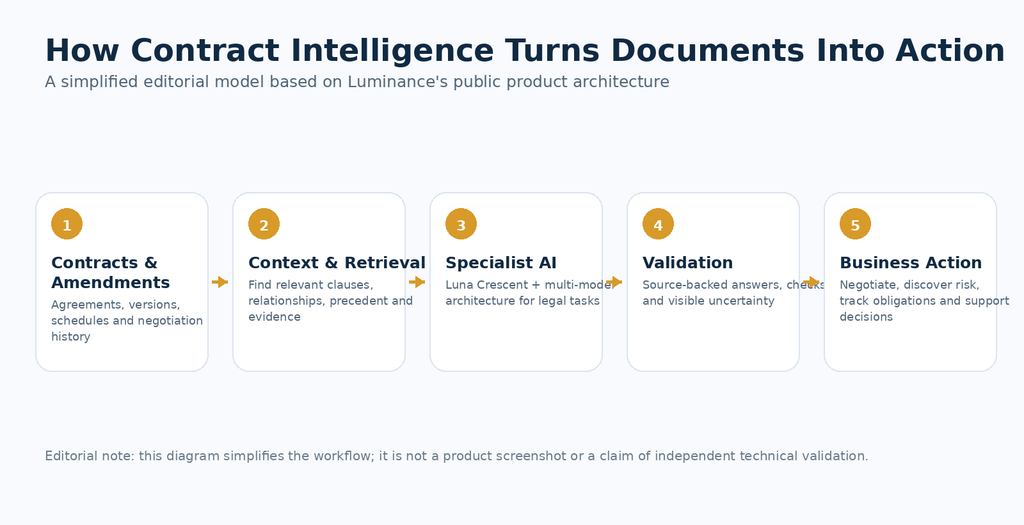
Figure 2. Simplified editorial model of a contract-intelligence workflow.
A Real-World Signal: Cryptomathic Broadens Access Beyond Legal
On September 24, Legal IT Insider reported that Danish IT security company Cryptomathic had deployed Luminance’s Contract Intelligence Platform. The stated aim was to make contract information more accessible across the business and reduce the number of routine queries handled by legal, risk and compliance. The report noted that important terms could be spread across master agreements, annexes, schedules and amendments, making basic questions time-consuming when every request has to pass through Legal. Source: Legal IT Insider, Sep. 24, 2026
Luminance’s own Cryptomathic customer story says teams in Sales, Finance, Sales Operations and IT can query the contract repository directly for information relevant to their roles, with Legal handling more complex issues. Because this is a vendor case study, the results should not be generalized to every company, but it does show the type of cross-functional use case behind the Contract Intelligence positioning. Source: Luminance customer story: Cryptomathic
How Luminance’s Current Legal-AI Architecture Is Presented
1. Context first — The platform emphasizes retrieving the relevant contracts, amendments, related documents and organizational precedent before asking a model to reason over the material.
2. Specialist intelligence — Luna Crescent is positioned as a legal-specialist model for high-volume extraction, classification and contract analysis, while general-purpose models can still be used where broader generative capabilities are stronger.
3. Multi-model routing — Luminance says different tasks can be directed to different models based on accuracy, speed, reliability and cost requirements instead of forcing all work through one model.
4. Validation and evidence — The company’s architecture pages emphasize source-backed answers, checks and validation for higher-impact outputs. This is especially important in legal workflows, where a fluent but unsupported answer can be dangerous.
5. Action across teams — The end goal is not only analysis. The platform is positioned to support negotiation, discovery, workflow automation, obligations, renewals and business decisions tied to contract terms.
Accuracy, Trust and the Limits of Legal AI
Legal AI should be judged on more than how polished its answers sound. A useful system needs to retrieve the right evidence, distinguish present information from missing information, preserve permissions, show where an answer came from and make uncertainty visible. Luminance’s public materials explicitly discuss source fidelity and validation, but buyers should still evaluate those claims against their own contracts and workflows before relying on automated outputs for material decisions. Source: Luminance technology architecture
Independent evaluation is also important. A July 2026 practitioner-style review by Legal AI Insights noted that independent benchmark data specific to Luminance remains limited and that vendor-disclosed performance claims should be interpreted within their stated methodology. That is a sensible editorial standard for any legal-AI product: distinguish what has been independently established from what a vendor reports about its own testing. Source: Legal AI Insights evaluation
For legal teams, human review remains essential where the answer could affect rights, liability, regulatory compliance or a major commercial decision. The most useful role for AI is often to narrow the search space, surface anomalies, organize evidence and accelerate first-pass analysis so that qualified professionals can focus their attention where judgment matters most.
What Legal-Tech Users Are Discussing
Community discussions can reveal what buyers care about, even though they should not be treated as verified market research. In a 2026 r/legaltech discussion based on 62 anonymized tool assessments, Luminance appeared alongside Harvey, Spellbook, Lexis+ AI, CoCounsel and Kira in buyer evaluations. The author characterized Luminance and Kira as more diligence-focused than some drafting or research-oriented alternatives. The sample is small and self-reported, so it is useful as a directional signal rather than a representative industry survey. Source: Reddit r/legaltech discussion
Other legal-tech discussions repeatedly raise the same practical questions: How reliable are the answers? What happens when information is missing? How much verification is needed? How does the tool fit existing workflows? And is the cost justified by the volume and complexity of work? Those questions are more useful than hype because they focus on implementation, governance and measurable value.
What These Updates Mean for Legal Teams and Businesses
Legal knowledge can become less person-dependent: If negotiation history, accepted positions and contract precedent are preserved in a usable form, organizations may reduce the risk of losing context when team members change roles or leave.
Contract data can serve non-legal teams: Finance may care about payment terms and renewals; Procurement about obligations and fallback positions; Sales about commercial commitments; Legal about risk and precedent. The same agreements can support different questions when access is governed appropriately.
Specialization is becoming a product differentiator: Luna Crescent reflects a broader legal-tech trend toward specialist models and domain-specific benchmarks rather than relying only on the biggest general-purpose model available.
Evidence is becoming part of the product experience: The LexisNexis alliance and Luminance’s emphasis on source-backed answers both point toward a future in which legal AI is expected to show the supporting material, not merely generate a confident response.
Governance will matter as much as automation: The more contract intelligence spreads beyond Legal, the more important permissions, auditability, data governance and escalation rules become. Self-service is valuable only when the boundaries are clear.
Luminance vs. General-Purpose AI: The Practical Difference
The clearest difference is not that general-purpose AI cannot read contracts. It can. The difference is the surrounding system. Enterprise contract work requires access controls, document relationships, portfolio-wide retrieval, version history, approved playbooks, organizational precedent and a way to verify conclusions against the underlying agreement. Luminance is building its value proposition around that system-level context, with Luna Crescent acting as one specialist component rather than the entire product.
That does not mean a specialist platform is automatically the right answer for every organization. A small team with a limited contract volume may prioritize simplicity and cost, while a global enterprise may value integration, governance, portfolio search and repeatable workflows more heavily. The right evaluation should begin with use cases and risk, not with a feature checklist.
Frequently Asked Questions
What is Luminance legal AI?
Luminance is an enterprise AI platform focused on contract intelligence, including negotiation, contract analysis, discovery, workflow automation and portfolio-wide access to contractual knowledge.
What is the latest Luminance Legal AI news in 2026?
Major 2026 developments include the January institutional-memory update, the April LexisNexis alliance, the June launch of Luna Crescent, the September Contract Intelligence strategy push and new enterprise deployment stories such as Cryptomathic.
What is Luna Crescent?
Luna Crescent is the first model in Luminance’s proprietary Luna family of legal-intelligence models. Luminance says it is trained for specialist contract tasks and operates within a broader multi-model architecture.
Does Luminance use only its own AI model?
No. Luminance publicly describes a multi-model architecture in which Luna Crescent works alongside general-purpose frontier models, with different tasks routed to the intelligence best suited to them.
What is Contract Intelligence?
Luminance defines Contract Intelligence as understanding, connecting and activating the content, history and context across an organization’s contracts so the information can support decisions and action.
Why does the LexisNexis alliance matter?
It is designed to bring authoritative LexisNexis legal content and citation-backed insights into Luminance workflows for mutual in-house customers, helping connect internal contract context with external legal research.
Can legal AI replace human legal review?
It can automate and accelerate parts of contract work, but material legal decisions still require appropriate professional judgment, especially when rights, liability, compliance or major commercial risk are involved.
Is every Luminance performance claim independently verified?
No. Some prominent figures, including Luna Crescent benchmark results, are reported by Luminance based on its own methodology. Responsible coverage should identify them as vendor-reported unless independent validation is available.
SEO & Publishing Notes for This Article
• Use the exact primary phrase “luminance legal ai news” naturally in the SEO title, H1, introduction and one relevant subheading. Do not force a fixed keyword density.
• Keep the article updated. News-intent pages benefit from visible publication and modification dates when meaningful new developments are added.
• Use descriptive image alt text such as “Luminance legal AI news 2026 timeline” and “contract intelligence workflow illustration.” Avoid repeating the exact keyword in every image.
• Link internally to relevant pages about legal AI, contract review, AI agents, enterprise AI, contract management or legal technology if those pages exist on your site.
• Keep external links editorial and contextual. Authoritative outbound references are useful for readers and make factual claims easier to verify.
• Do not publish vendor performance claims as neutral fact. Attribute them clearly and explain when independent validation is limited.
• For FAQ structured data, only mark up questions and answers that are visibly present on the page. For the main article, Article or NewsArticle schema can be appropriate depending on your publishing model.
[…] internal manual explains that the statutory framework allows HMRC to require specified information in support of an R&D claim and that, where the required information is not provided, the claim […]