
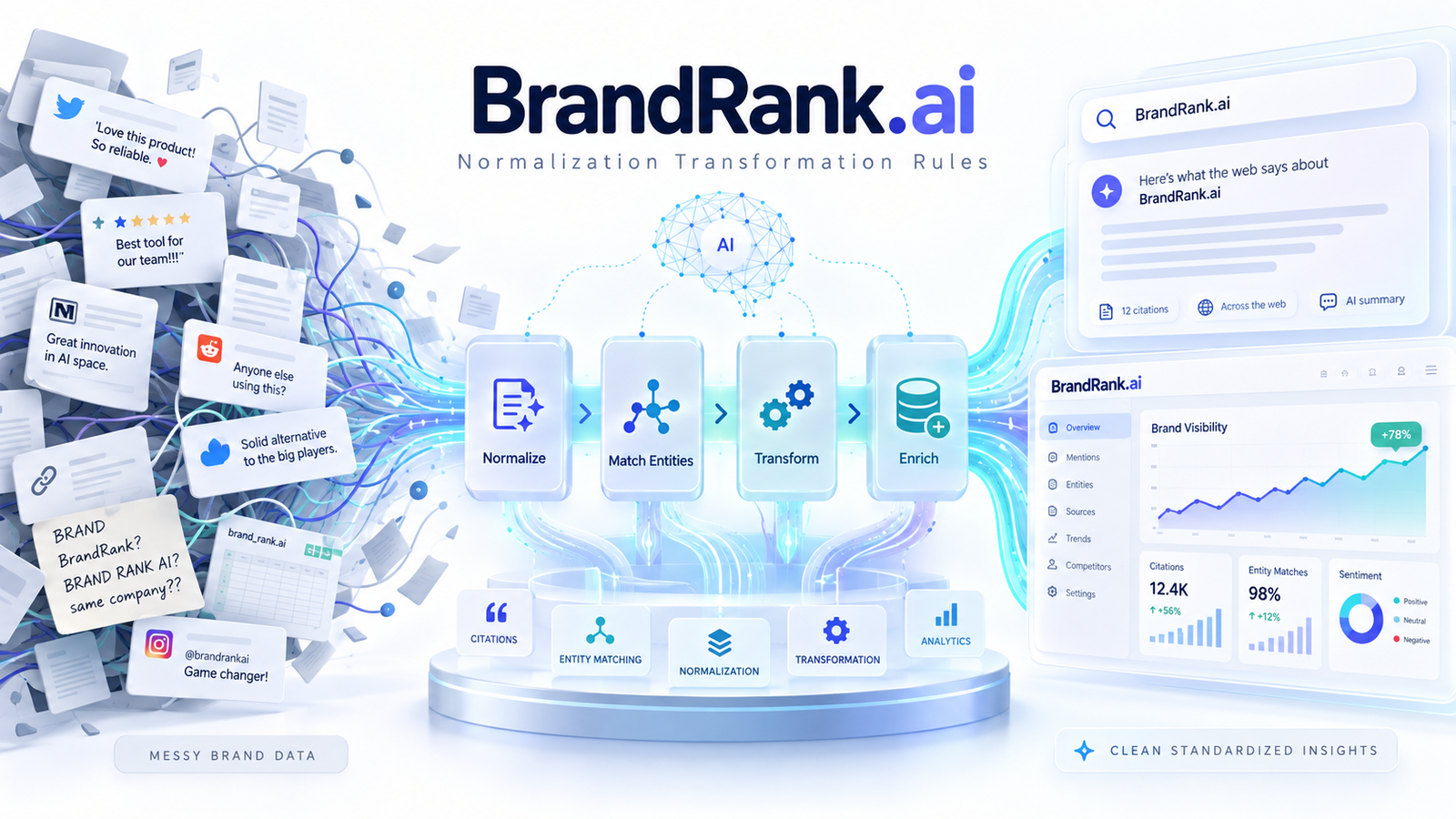
AI search has changed the way people discover brands. Instead of opening ten blue links, a customer can now ask ChatGPT, Gemini, Perplexity, Claude, Grok, Meta AI, or DeepSeek for a recommendation and receive a direct answer. For brand-monitoring platforms, that creates a new data problem: the same brand may appear under different names, URLs, products, locations, sources, and wording across thousands of AI answers.
That is where normalization and transformation become useful concepts. Normalization makes inconsistent data consistent. Transformation turns cleaned data into fields and signals that can be measured. Together, they help an analytics system avoid counting the same brand twice, mixing unrelated entities, or treating different URL versions as separate sources.
The keyword “brandrank.ai normalization transformation rules” is therefore best understood as a technical and practical search topic, not as the name of a confirmed public BrandRank.AI specification. BrandRank.AI’s own public material focuses on AI search visibility, Recommendation Share™, content readiness, brand risk and the sources and claims shaping AI answers.
| Simple definitionNormalization = make the data consistent. Transformation = convert the cleaned data into a useful structure for analysis. Example: “Brand Rank AI”, “brandrank.ai” and “BrandRank” may be mapped to one canonical brand entity, while an AI answer can be transformed into fields such as brand mentioned, cited source, claim, answer engine, locale and date. |
What Is BrandRank.AI?
BrandRank.AI is an AI brand-monitoring and Answer Engine Optimization (AEO) platform. Its public website says it tracks must-win prompts across seven AI answer engines and focuses not only on whether a brand is visible, but whether it is actually recommended. The platform describes this recommendation-focused measurement as Recommendation Share™.
According to the BrandRank.AI FAQ, AI search visibility measures whether and to what extent a brand is cited in AI-generated answers. The company also describes capturing answers, sources and claims so teams can understand why a brand is included, ignored or placed at risk.
This matters because raw AI responses are messy. The same company may be named in several ways, URLs can include tracking parameters, and a model may mention a product when the analysis actually needs the parent brand. Clean measurement depends on resolving those differences before calculating trends.
Are “Normalization Transformation Rules” an Official BrandRank Feature?
Based on the public BrandRank.AI pages reviewed for this article, there is no published technical manual or feature page with the exact title “Normalization Transformation Rules.” That distinction is important. A useful article should not invent proprietary formulas, hidden thresholds, regex patterns, or database rules and present them as confirmed BrandRank technology.
A safer and more useful approach is to explain the normalization and transformation practices that are commonly needed in AI brand intelligence, while clearly separating those practices from BrandRank’s publicly documented features. This gives readers a practical answer without pretending to know private implementation details.
Normalization vs. Transformation
The two terms are related, but they solve different problems.
| Concept | Main job | Simple example |
|---|---|---|
| Normalization | Standardize inconsistent data so equivalent values can be treated as the same thing. | “Brand Rank AI”, “BRANDRANK.AI” and “brandrank.ai” → one canonical entity: “BrandRank.AI”. |
| Transformation | Convert cleaned data into a new structure that is easier to analyze. | Raw AI response → brand mention, citation source, claim, engine, locale, date and recommendation status. |
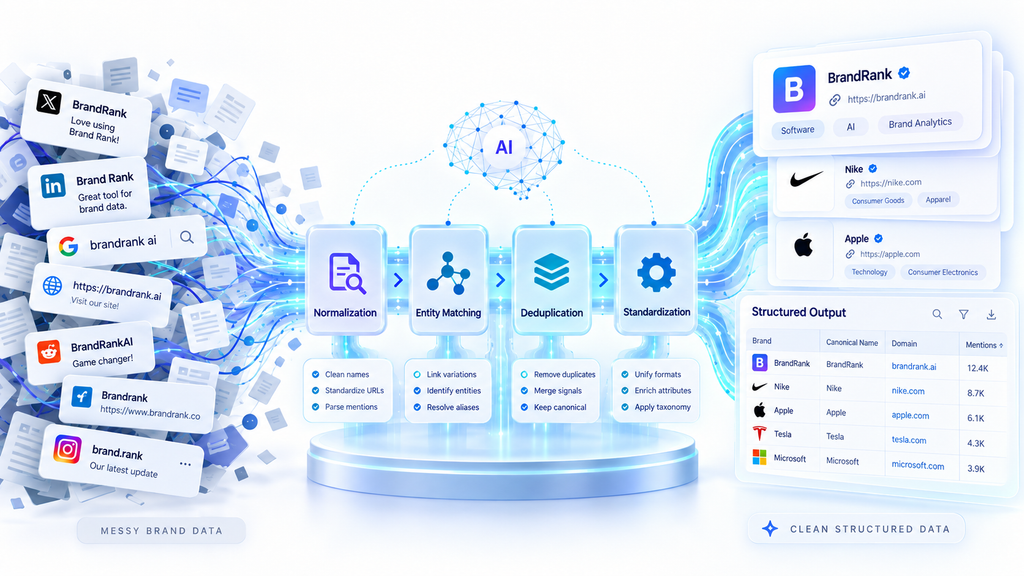
Figure 1. A practical normalization pipeline: aliases and inconsistent URLs are matched, deduplicated and converted into clean structured brand data.
Why Normalization Matters in AI Brand Monitoring
AI answers are not database rows. They are natural-language responses assembled from model knowledge, retrieved sources and the wording of a user prompt. That means the same underlying entity can appear in many forms. Without normalization, the analytics can become misleading.
- A brand mention can be split across multiple spelling or capitalization variants.
- Tracking parameters can make one source URL look like several different sources.
- A parent company, product and sub-brand can be incorrectly merged into one entity.
- The same citation can be counted multiple times if URL variants are not deduplicated.
- Regional or language versions can be wrongly combined, hiding real market differences.
- Historical reports can change unexpectedly if old records are overwritten instead of versioned.
Good normalization reduces this noise while preserving the original evidence. The goal is not to make every record identical. The goal is to make equivalent records comparable without deleting meaningful differences.
Practical Normalization Rules for Brand Data
1. Brand Name Canonicalization
Choose one preferred name for the entity, then map safe variations to it. For example, “Brand Rank AI”, “BrandRank AI” and “BrandRank.AI” may all point to the same canonical organization when the context confirms they refer to that company. The original wording should still be stored for auditing.
2. Case, Whitespace and Punctuation Cleanup
Differences such as extra spaces, repeated punctuation or inconsistent capitalization usually should not create a new entity. A system can trim whitespace, normalize Unicode characters and compare case-insensitively while keeping a display-friendly canonical form.
3. URL Normalization
URLs often need their own rules. Common cleanup includes normalizing protocol and host casing, removing obvious tracking parameters, handling trailing slashes consistently and resolving known redirect or canonical variants. However, query parameters that materially change page content should not be removed automatically.
Google calls the process of selecting a representative URL from duplicate or very similar pages canonicalization. Google also explains that redirects, rel=”canonical” annotations and sitemap signals can influence which URL is treated as canonical.
4. Entity and Alias Resolution
A strong system should distinguish between a company, its products and similarly named businesses. Alias matching should use more than the visible name. Domain, official website, category, location, product context and linked identity signals can help determine whether two mentions really describe the same entity.
5. Citation Deduplication
If an AI answer cites the same article through multiple URL variants, counting each version separately can inflate source influence. Deduplication should cluster equivalent URLs while preserving the exact cited URL in the raw record.
6. Locale and Language Separation
Do not over-normalize country or language variants. A brand may have different websites, legal entities, pricing, products or reputation signals in the United States, United Kingdom, Pakistan or another market. A useful record should retain locale and language even when the parent brand is the same.
7. Date and Time Standardization
Dates should use one consistent format and timezone policy so trend comparisons remain accurate. The raw timestamp can be kept while a normalized UTC or reporting-zone timestamp is created for analysis.
Transformation Rules: Turning AI Answers Into Measurable Data
Once the data is normalized, transformation converts it into a structure that can be searched, filtered, scored and compared. A raw AI answer may be transformed into fields such as:
- Prompt or question asked
- Answer engine used
- Brand mentioned: yes or no
- Canonical brand entity
- Recommended, compared, criticized or simply mentioned
- Cited source and normalized source domain
- Key claim extracted from the answer
- Product or category discussed
- Locale and language
- Timestamp and observation period
- Confidence or human-review status for uncertain entity matches
These fields are examples of a practical analytics model, not a claim about BrandRank.AI’s private database schema. The value of transformation is that thousands of unstructured answers can be turned into comparable observations without losing access to the original response.
Example: From Messy Input to Structured Output
Imagine an AI answer says: “Brand Rank is a strong option for teams looking to monitor AI visibility. See brandrank.ai and the company’s research page for more details.” The raw response is useful to a human, but it is not yet ideal for reporting.
| Stage | Example | Purpose |
|---|---|---|
| Raw input | Brand Rank … brandrank.ai … | Preserve the exact AI answer. |
| Normalized entity | BrandRank.AI | Map verified aliases to one canonical entity. |
| Normalized domain | brandrank.ai | Group safe URL variants under one source domain. |
| Transformed observation | mentioned = yes; context = positive option; source domain = brandrank.ai; engine = X; locale = Y | Create fields that can be compared across prompts and dates. |
| Audit record | raw answer + normalized values + transformation version | Make future review and correction possible. |
How This Connects to BrandRank.AI’s Documented Metrics
Normalization and transformation are useful because metrics only make sense when the underlying observations are comparable. BrandRank.AI publicly highlights several measurements and workflows that depend on consistent observations across prompts, engines and time periods.
- AI search visibility: whether and to what extent a brand appears or is cited in AI-generated answers.
- Recommendation Share™: BrandRank’s emphasis on whether the brand is actually recommended, not merely visible.
- Content readiness: whether a brand’s content is structured and useful enough to support AI discovery and answers.
- Brand risk or vulnerability: identifying unfavorable, disputed, outdated or risky claims and tracing them back to sources.
- Citations and claims: understanding which sources and statements are shaping how answer engines describe a brand.
BrandRank’s current home page states that it tracks major answer engines including ChatGPT, Gemini, Perplexity, Grok, Claude, Meta AI and DeepSeek. See the BrandRank.AI platform overview and its Brand Risk Monitor announcement for the company’s public description of these capabilities.
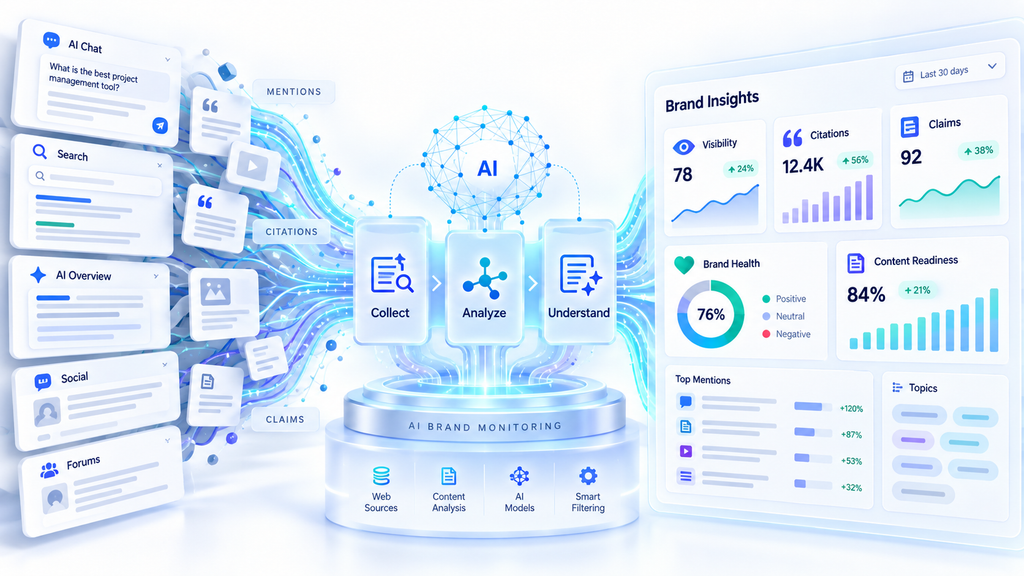
Figure 2. AI brand monitoring converts mentions, citations and claims into comparable signals such as visibility, brand health and content readiness.
Normalization, Entity SEO and Structured Data
The same principle of clear identity also matters on the open web. Search engines and AI systems need consistent signals about who an organization is, which website is official and which pages or profiles refer to the same entity.
Google’s Organization structured data documentation recommends providing relevant organization information on a home or organization page. Google can also make general use of schema.org properties such as sameAs. Schema.org defines sameAs as a URL that unambiguously indicates an item’s identity.
For a brand, that means consistent organization names, canonical URLs, official profiles and valid structured data can reduce ambiguity. This does not guarantee inclusion in an AI answer, but it gives machines cleaner identity signals to work with.
Common Mistakes to Avoid
- Presenting an invented normalization formula as an official BrandRank.AI algorithm.
- Merging two companies just because their names are similar.
- Removing every URL parameter without checking whether it changes page content.
- Treating a product mention as a parent-company mention in every case.
- Deleting raw values after normalization, which makes audits difficult.
- Changing old normalized records without recording which rule version was used.
- Using automated sentiment or claim labels without review when the context is ambiguous.
- Ignoring locale, language, product line or category context.
Best-Practice Rule Set
- Preserve the raw AI answer, original URL and original entity string.
- Create a separate canonical value rather than overwriting the raw value.
- Use deterministic rules for simple cleanup such as spaces and safe URL normalization.
- Use entity context for aliases instead of relying on name similarity alone.
- Keep product, sub-brand, parent company and regional entity relationships explicit.
- Deduplicate equivalent citations, but retain every observed citation event.
- Store the transformation rule version so historical reports remain reproducible.
- Route uncertain matches to human review instead of forcing a guess.
- Validate important identity signals with official websites and structured data where possible.
- Re-test rules as brands, domains, products and answer-engine behavior change.
Frequently Asked Questions
Is “BrandRank.ai normalization transformation rules” an official BrandRank.AI feature?
No public BrandRank.AI page reviewed for this article uses that exact phrase as the name of a proprietary feature or published rulebook. It is more accurate to use the phrase as a practical description of how brand data can be cleaned and converted for reliable AI-search analysis.
What is normalization in simple words?
Normalization means making equivalent data look consistent. If one brand appears as “Brand Rank AI”, “BrandRank.AI” and “brandrank.ai”, normalization can map those verified variations to one canonical entity while keeping the original text.
What is transformation?
Transformation changes data into a more useful structure. A long AI response can be transformed into fields such as brand mentioned, source cited, claim, answer engine, date and locale.
Is URL normalization the same as Google canonicalization?
They overlap but are not identical. URL normalization is a broader data-cleaning practice. Google canonicalization specifically concerns selecting a representative URL among duplicate or very similar pages for Search. Analytics systems can use canonical signals as evidence, but they still need their own careful source-resolution rules.
Why should raw data be preserved?
Rules can change and automatic matches can be wrong. Keeping the raw answer, source and original entity string makes it possible to audit a decision, correct an error and reproduce an older report.
Can normalization improve AI visibility?
Normalization itself does not make an AI model recommend a brand. It improves measurement and diagnosis. Clear brand identity, useful content, authoritative sources and consistent structured information can support discoverability, but recommendation behavior depends on many factors outside a single normalization rule.
What should a brand normalize on its own website?
Start with the basics: one clear organization name, a preferred domain and canonical URL strategy, consistent business details, accurate Organization structured data, official profile references, clean product naming and sensible redirects for obsolete or duplicate URLs.
Final Takeaway
The most useful way to understand BrandRank.ai normalization transformation rules is as a data-quality framework for AI brand intelligence. Normalization resolves safe variations in names, URLs and entities. Transformation turns cleaned observations into structured signals that can be measured across prompts, sources, engines and time.
The key is accuracy. Do not confuse a practical normalization workflow with a confirmed private BrandRank.AI algorithm. BrandRank publicly documents the outcomes it measures—visibility, recommendations, content readiness, risk, citations and claims—while its exact internal transformation logic is not publicly specified. A reliable implementation should therefore preserve raw evidence, use explicit canonical values, avoid over-merging entities and keep every transformation auditable.