
Artificial intelligence is becoming part of the daily AEC workflow—not only as a writing or image tool, but as a layer inside project platforms, BIM software, drawings, specifications, schedules and field data. This guide explains the most important developments, what is working now, and where professional judgment remains essential.
By Zulqarnain Zilli | Published: July 27, 2026 |
| KEY TAKEAWAYSAI adoption across AEC remains uneven, but firms already using it report significant time and cost savings.The biggest 2026 shift is from standalone chatbots toward AI embedded in project data, BIM, document and field workflows.Conversational modeling, agentic project assistants and construction-specific document analysis are becoming practical products.The highest-value use cases reduce searching, summarizing, repetitive documentation, coordination and early risk detection.Accuracy, security, ownership, liability and traceability require a formal human-in-the-loop governance process. |
|---|
Architecture, engineering and construction—collectively known as AEC—has spent years discussing the promise of artificial intelligence. In 2026, the conversation is becoming more concrete. Autodesk Assistant is moving into connected construction workflows, Revit is testing conversational model actions, and Trimble has connected SketchUp with Claude for prompt-based 3D modeling.
At the same time, adoption is not universal. Bluebeam’s 2026 AEC Technology Outlook reported that only 27% of surveyed AEC firms used AI for automation, problem-solving or decision-making. Yet among adopters, 68% reported saving at least $50,000, 46% reported saving 500–1,000 hours, and 94% planned to expand AI use. The signal is clear: the industry is early, but useful applications are moving beyond experiments.
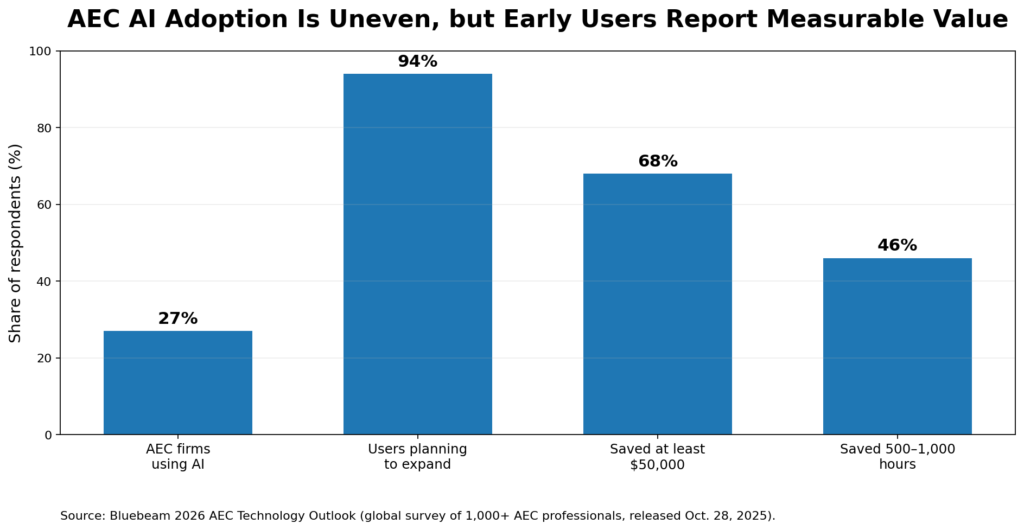
Figure 1. AEC AI adoption remains limited, while early adopters report measurable value. Source: Bluebeam 2026 AEC Technology Outlook.
What Does “AEC AI” Mean?
AEC AI refers to artificial intelligence systems designed for—or applied to—architecture, engineering and construction work. The category includes generative AI, machine learning, computer vision, natural-language interfaces, optimization systems, predictive models, robotics and AI agents.
The most useful distinction is not whether a product uses the label “AI.” It is whether the system can work with trusted project context and produce an output that improves a real workflow. In AEC, that context may include BIM models, drawings, specifications, contracts, RFIs, submittals, schedules, cost data, site imagery and asset records.
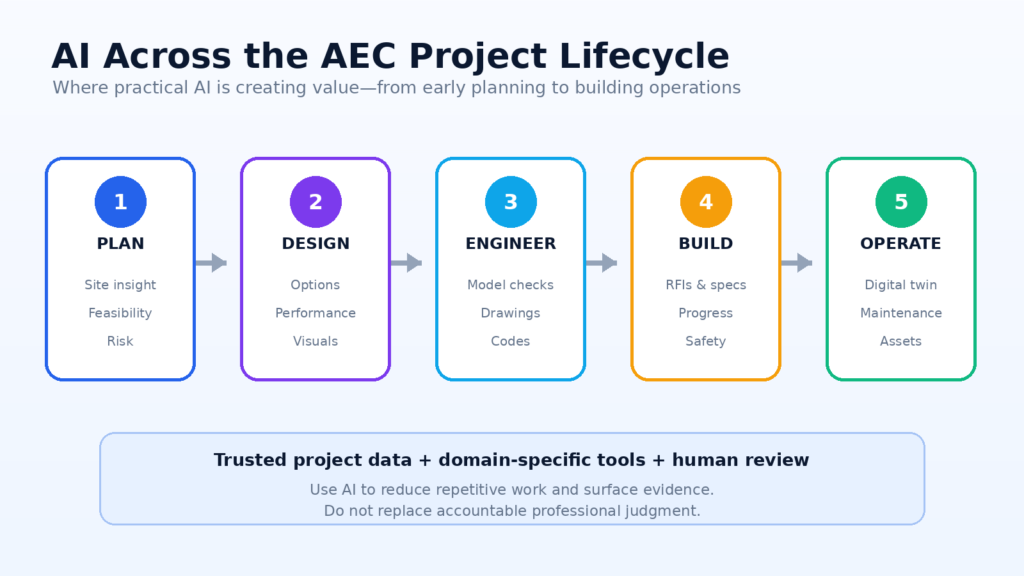
Figure 2. Practical AI value appears across the full AEC lifecycle, but it depends on project data and human review.
Latest AEC AI News: The Developments Defining 2026
1. AI is moving from a separate chatbot into the project environment
In June 2026, Autodesk said its Assistant for construction workflows in Forma was moving out of beta. The product is positioned as a project-level agent that can work across connected specifications, issues, RFIs and other project information. The strategic significance is context: users do not have to move sensitive project material into a disconnected consumer chatbot before asking questions.
For AEC firms, embedded AI can reduce the time spent switching platforms, building reports and searching for the latest information. It can also create new governance questions because the quality of the answer depends on permissions, data completeness, version control and the system’s ability to cite its sources.
2. Natural language is becoming a new interface for BIM and 3D modeling
Two 2026 announcements show how prompts are beginning to operate professional modeling tools. Autodesk Assistant in Revit entered a technology preview with supported actions such as creating schedules and floor plans through natural-language instructions. Separately, Trimble linked SketchUp with Anthropic’s Claude, allowing users to generate and refine 3D geometry using text, speech, reference images, sketches, floor plans and dimensions.
This does not remove the need to understand geometry, constructability, standards or design intent. It does, however, lower the interaction cost of creating, querying and revising models. The likely long-term interface is hybrid: professionals will continue using direct modeling tools while also delegating bounded tasks to an assistant.
3. Construction-specific document intelligence is becoming strategic
On April 2, 2026, Trimble announced an agreement to acquire Document Crunch, a company focused on AI analysis of construction contracts, specifications and compliance obligations. Trimble said the technology had been deployed on more than 10,000 projects and was intended to surface risks such as payment disputes, notification failures and specification non-compliance.
The news supports a broader trend: generic text generation is less valuable than domain-specific systems that understand the structure, terminology and consequences of construction documents. A tool that identifies an obligation should show the exact clause, document version and project context so a qualified user can verify it.
4. AI-assisted engineering documentation is becoming “human in the loop” by design
Trimble’s 2026 Tekla release includes AI Cloud Fabrication Drawings, described as a human-in-the-loop service that uses an organization’s prior drawing libraries to generate fabrication drawings. It also includes an early AI model and drawing assistant for natural-language modeling operations.
The “human in the loop” wording matters. Fabrication and engineering documents are not low-stakes marketing copy. They affect procurement, manufacturing, installation and safety. AI can accelerate first-pass production, but documented review and approval remain central to professional responsibility.
5. The industry is beginning to benchmark whether AI can actually reason across AEC documents
Released in March 2026, AEC-Bench is an open multimodal benchmark for evaluating agentic systems on real AEC tasks, including drawing understanding, cross-sheet reasoning and project-level coordination. This is important because impressive demonstrations do not always reveal whether a system can consistently connect a note on one sheet with a detail, specification or constraint elsewhere in the document set.
Benchmarks will not replace project validation, but they can make product claims more testable. Buyers should increasingly ask vendors for task-level accuracy, failure examples, source traceability and performance on documents similar to their own.
The 10 Most Important AEC AI Trends in 2026
1. Project-level AI agents
AI assistants are evolving from tools that answer a single question into agents that can coordinate across project data and support actions. The near-term value is not a fully autonomous project manager. It is a controlled assistant that can assemble information, draft routine records, flag changes and prepare a decision for human review.
2. Conversational BIM, CAD and model querying
Natural-language interfaces are reducing the need to remember every command or manually navigate complex menus. Professionals can ask questions about a model, request a schedule, generate a view or describe an early massing concept. Successful use still requires constraints, model standards and checking.
3. AI document and contract intelligence
Specifications, contracts, submittals and RFIs are high-value targets because they contain obligations distributed across thousands of pages. Domain-specific AI can help find clauses, compare revisions, summarize risk and route tasks. The system should always link its finding to the source text.
4. Multimodal drawing understanding
AEC information is not only text. It is spatial and graphical. Multimodal systems are being trained and evaluated to read plans, details, symbols, schedules and annotations together. Cross-sheet reasoning is one of the most important technical challenges for reliable AEC agents.
5. Predictive planning and early risk detection
Connected historical and live project data can help surface schedule pressure, procurement risk, missing information and coordination issues earlier. Predictions should be treated as decision support rather than certainty, especially when the training data is incomplete or not representative.
6. Automated takeoff and estimating assistance
AI can help classify scope, read quantities, compare addenda and prepare a first-pass takeoff. Estimators still need to understand exclusions, constructability, production assumptions and local market conditions. The most defensible workflow keeps a visible evidence trail from quantity to source drawing.
7. Spatial AI, computer vision and progress verification
Cameras, drones, laser scans and mobile robots can capture field conditions and compare them with models or schedules. This supports progress documentation, quality checks and safer data collection. The key shift is from AI that only reads documents to AI grounded in what is physically happening on site.
Further reading: Autodesk’s 2026 expert outlook on spatially grounded construction AI.
8. Construction robotics and task-specific automation
Robots are already useful for narrow tasks such as site capture, material handling and repetitive physical work. ASCE has highlighted how robots can collect consistent site data and enter unsafe areas, while task-specific equipment can reduce strain on workers. Full autonomy remains far more difficult than a controlled, repeatable scope.
Research context: ASCE on AI and robotics in construction projects.
9. Private, governed and organization-specific AI
AEC firms manage confidential client information, security-sensitive plans and proprietary standards. Adoption will increasingly depend on approved platforms, permissions, retention policies, transparency cards, private model options and internal knowledge bases. Data governance is a product requirement, not an afterthought.
10. Human expertise becomes the control layer
As AI generates more content, professional value shifts toward defining intent, checking assumptions, resolving ambiguity, understanding codes, communicating with stakeholders and accepting responsibility. The strongest firms will combine AI speed with documented human judgment.
What Practitioners Are Saying on Reddit and YouTube
Community discussions are useful for identifying pain points, language and objections, but they should not be treated as scientific evidence. Use them to discover questions, then verify factual claims through primary sources.
| Practitioner signal | Why it matters | Editorial use |
|---|---|---|
| AI-altered renderings can change materials, proportions and design details | Firms may lose control over accuracy and representation of their work | Add a section on visualization disclaimers, ownership and approval of externally modified images |
| Construction teams want administrative friction solved before “science-fiction” automation | Users value document comparison, file organization and finding exclusions | Prioritize practical workflows rather than broad claims of full project autonomy |
| Professionals worry that automating thinking-intensive work can weaken learning | Junior staff need exposure to scope interpretation and coordination | Design AI workflows that preserve review, explanation and skill development |
Community references: r/Architects discussion on AI-altered renderings • r/Construction discussion on practical AI priorities • Autodesk video on AI, collaboration and the future of design • Autodesk Construction discussion on CAD’s future in AEC
Where AI Can Create the Most Value
- Search and knowledge retrieval: Find the relevant drawing, clause, RFI, issue or past decision without manually opening dozens of files.
- Document preparation: Draft meeting recaps, daily logs, submittal summaries, risk registers and routine correspondence for review.
- Revision comparison: Highlight what changed between drawing or specification versions and direct users to affected scope.
- Early design exploration: Generate and compare options for massing, layouts, daylight, performance, cost or carbon before detailed design.
- Quality and consistency checks: Identify missing information, inconsistent naming, unusual details or data gaps across connected project records.
- Field documentation: Use imagery, sensors and robotics to capture progress consistently and support safer inspection of difficult areas.
- Skills access: Help users find trusted software guidance and organizational standards inside the tools they already use.
Risks, Limitations and the Need for Human Review
AEC work has legal, financial, safety and public consequences. An AI-generated answer can sound confident while missing a note, using an outdated document or inventing a relationship that is not present. The risk is highest when users cannot inspect the source or do not know the boundaries of the system.
- Inaccurate outputs: Hallucinated dimensions, requirements, codes, quantities or project facts.
- Version confusion: An answer based on superseded drawings, old specifications or an unapproved model.
- Data security: Sensitive plans, client information or proprietary methods uploaded to an unapproved service.
- Ownership and authenticity: Unclear rights over generated images, models, training data and altered client-facing renderings.
- Bias and incomplete training data: Recommendations that do not reflect local codes, site conditions, firm standards or project types.
- Liability: Unclear responsibility when an AI-assisted output influences design, cost, schedule, safety or compliance.
- Automation complacency: Reduced attention, loss of skill development and overreliance on an apparently authoritative interface.
- Integration failure: A technically impressive tool that cannot connect to current project systems, permissions or workflows.
A systematic review of AI and robotics ethics in AEC identified issues including privacy, security, transparency, reliability, safety, surveillance, trust and liability. Read the academic review.
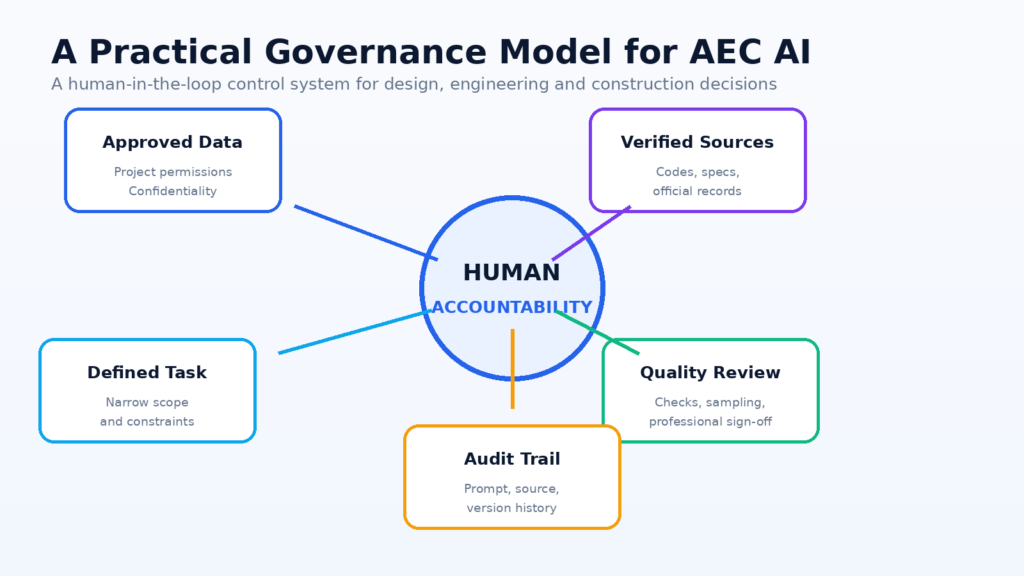
Figure 3. A simple governance model keeps accountable professionals at the center of AI-assisted work.
Will AI Replace Architects, Engineers or Construction Managers?
AI is more likely to reshape tasks than eliminate the need for accountable AEC professionals. Routine searching, drafting, formatting and documentation will become faster. Some early design and modeling tasks will become more accessible. But buildings and infrastructure exist in physical, regulatory and social contexts that require negotiation, responsibility and judgment.
The AIA’s 2025 research found that only 6% of architectural professionals regularly used AI at work and only 8% of firms had implemented AI solutions, while 20% were working on implementation. The same study found that nearly 90% were concerned about issues such as inaccuracies, security, authenticity and transparency. See the AIA research summary.
The practical conclusion is “amplification with accountability.” People who understand both the profession and the technology will be able to produce more options, find information faster and spend more time on decisions. Firms that remove professional review in the name of speed may create new risk rather than value.
A 90-Day AI Adoption Plan for AEC Firms
Days 1–15: Choose one low-risk workflow
Select a repetitive task such as meeting summaries, internal document search, file naming, software help or first-pass comparison. Record the current time, error rate and user frustration.
Days 16–30: Approve data and tools
Define what information may be uploaded, who can access it, how long it is retained and which tools are approved. Avoid using live confidential project data in an unapproved pilot.
Days 31–45: Create a test set
Use representative documents with known answers. Include easy and difficult cases, superseded files, missing information and ambiguous language. Document expected outputs.
Days 46–60: Run the pilot with human review
Require users to verify claims against drawings, models, specifications or records. Log failures, unclear answers and time saved.
Days 61–75: Measure real value
Compare the pilot with the baseline. Track saved time, rework, missed issues, adoption, user trust and the cost of review.
Days 76–90: Decide whether to scale
Expand only when the workflow has clear ownership, acceptable error controls, source traceability and a measurable benefit. Publish an internal standard operating procedure.
Questions to Ask an AEC AI Vendor
- Which exact tasks does the system perform, and which tasks are out of scope?
- What project data can it access, and how are permissions inherited?
- Does every material answer link to the source document, sheet, clause or model object?
- How does the system detect superseded documents and maintain version context?
- Is customer data used to train shared models? What are the retention and deletion controls?
- What accuracy or failure-rate data is available for AEC documents similar to ours?
- Can we export an audit trail of prompts, inputs, outputs, sources and approvals?
- How are model updates, security incidents and regulatory changes communicated?
- Can the tool integrate with our current CDE, BIM, project management and identity systems?
- What is the process for human review, correction and escalation?
Frequently Asked Questions
What does AEC stand for?
AEC stands for architecture, engineering and construction. The term covers the organizations and professionals involved in planning, designing, engineering, building and operating the built environment.
What is AEC AI?
AEC AI is the use of artificial intelligence in architecture, engineering and construction workflows. Examples include model assistants, drawing analysis, document search, cost estimation, computer vision, predictive planning and robotics.
What is the biggest AEC AI trend in 2026?
The most important shift is embedded, context-aware AI. Instead of sending isolated text to a generic chatbot, users increasingly interact with assistants inside BIM, project and document platforms that can work with authorized project information.
Can AI read construction drawings?
Multimodal AI can identify and reason about parts of drawings, but reliability varies by task, document quality and system. Cross-sheet coordination, small notes, symbols, revisions and project-specific conventions remain difficult. Critical findings must be verified.
Can AI create a BIM or 3D model?
New tools can create or modify supported model elements from natural-language prompts, images and dimensions. The output still requires review for geometry, constructability, standards, data structure and design intent.
Will AI replace architects and engineers?
AI will automate or accelerate parts of the workflow, but professional responsibility, code interpretation, stakeholder coordination, safety decisions and contextual design judgment remain human responsibilities.
Is Reddit a reliable source for an AEC AI article?
Reddit is useful for discovering real concerns and language used by practitioners. It should be labeled as community discussion and should not be the sole evidence for statistics, legal claims, product performance or technical conclusions.
How often should an AEC AI news article be updated?
Review it monthly and update it after major product releases, acquisitions, research benchmarks, regulations or professional guidance. Keep a visible “last updated” date and remove claims that are no longer current.
What schema should be used for this article?
Use NewsArticle if the page is maintained as current news coverage. Use BlogPosting for a conventional editorial article. Include headline, image, author, publisher, datePublished, dateModified and mainEntityOfPage where applicable.
Final Analysis
The latest AEC AI news does not point to one tool taking over the industry. It points to a new interface layer across the project lifecycle. AI is becoming better at finding information, interacting with models, interpreting documents, organizing evidence and assisting with decisions. The firms most likely to benefit are not those that automate everything. They are those that identify narrow, high-value problems; connect AI to reliable project context; measure the result; and preserve professional accountability.
For readers, the most useful question is no longer “Can AI do AEC work?” It is: “Which part of this workflow can AI improve, what evidence will it use, and who is responsible for checking the result?”
Editorial Methodology and AI Disclosure
Research method: This article was prepared from official company announcements, professional association research, a global AEC survey, academic papers, Google Search documentation, practitioner discussions and industry video material. Product claims are attributed to their publishers. Reddit and YouTube material is used as qualitative context, not as proof of product performance or industry-wide prevalence.
AI assistance disclosure: AI was used to organize research, structure the draft and support editing. The article should receive a final human review before publication, including checking every linked source, product availability, dates, numbers and any legal or technical statements relevant to the publisher’s jurisdiction.
Recommended author enhancement: Add a named author bio, an original expert quote, a tested workflow or screenshot, and a short note describing the author’s AEC or technology experience. These additions make the article more useful and distinguish it from generic summaries.
Sources and Research Links
1. Bluebeam — 2026 AEC Technology Outlook press release — Adoption, ROI, investment and barrier statistics.
2. American Institute of Architects — AI adoption research — Architecture adoption, use cases and concerns.
3. Autodesk — Assistant for construction workflows in Forma — Project-level agent, connected data and governance context.
4. Autodesk — Assistant in Revit technology preview — Conversational Revit support and supported model actions.
5. Autodesk — 2026 AI construction trends — Expert perspectives on embedded AI, spatial intelligence, risk and human oversight.
6. Trimble — SketchUp integration with Claude — Conversational 3D modeling announcement.
7. Trimble — Agreement to acquire Document Crunch — Construction document analysis and risk management.
8. Trimble — Tekla 2026 release — Human-in-the-loop fabrication drawings and AI model assistance.
9. AEC-Bench — multimodal benchmark for AEC agentic systems — Drawing understanding, cross-sheet reasoning and project coordination.
10. Ethics of AI and Robotics in AEC — academic review — Privacy, transparency, safety, reliability, surveillance and liability.
11. ASCE — How AI can benefit construction projects — Robotics, field data capture and worker support.
12. Reddit r/Architects — AI-altered rendering discussion — Qualitative practitioner concerns about accuracy and control.
13. Reddit r/Construction — practical AI priorities discussion — Qualitative workflow pain points and adoption skepticism.
14. YouTube — Autodesk: AI, Collaboration and the Future of Design — Industry event recap and design discussion.
15. YouTube — Autodesk Construction: CAD’s Promising Future in AEC — CAD, AI, data security and collaboration discussion.
16. Google Search Central — Helpful, reliable, people-first content — Official content quality and AI-use guidance.
17. Google Search Central — Article structured data — Official Article, NewsArticle and BlogPosting guidance.
18. Google Search Central — Image SEO best practices — Image filenames, placement, captions and alt text.
19. Google Search Central — Link best practices — Crawlable links and descriptive anchor text.
20. Google Search Central — Spam policies — Scaled content abuse and search quality policies.